
this is the first successful website I’ve ever built http://bestjokes.xhost.ro/ – it’s somehow still alive :))
The engagement of this website was through the roof << that’s like the only success metric, of course.
Beware of the language on the site and in all content placed there.
I also want to take a moment to remember two important personalities from those times: Ferry Bazatu’ and Bebe. May God rest their spirits. They were some of the funniest people ever. And had the guts to join us and help create jokes for the site.
Weird part is: even the forum is still alive, which was made back in the day on a platform called invisionboard. Now it’s been bought by Tapatalk and resurrected.
So – website and forum are both alive. Thanks Crisan Marius and Bogdan Bogdan for showing me this.
Shoutouts go to Nertan Lucian Radu Prodan Măcicăşan Tudor – you know what this is.
Crazy Egg – growth with dev kits
Here are the first growth steps that allowed Crazy Egg to gain their first 100,000 users:
1. They created a simple opt-in page with a screenshot of a beta of their product.
2. Their ideal customers were web-designers, so they invested $10K into ads on various CSS galleries.
Result: 20,000 emails gained from their simple opt-in page.
3. Once they launched the product, they notified the email subscribers.
4. They submitted their CSS design to CSS galeries.
Result: 23,294 new visitors for free.
5. They offered all the big and small tech blogs a free $99 Crazy Egg account and helped them to set it up.
Result: TechCrunch, Mashable and a ton of other more or less popular tech news blogs covered Crazy Egg.
6. By attending hosting conferences, they offered parnership to hosting companies: a free Crazy Egg account for every new user + 30% commission when they upgrade to the paid plan.
7. By networking at SEO events, they offered a free $99 Crazy Egg account to SEO agencies (if they like it, they will recommend it to their customers for free).
Result: over 4,000 signups.
8. They were speaking at conferences. But instead of getting a speaking fee + traveling expenses, they kindly asked them to make Crazy Egg a sponsor of their event. It costs nothing to organizers. They agreed.
9. They noticed that people love sharing their heatmaps so they made the process as easy as possible.
Result: referral traffic has increased.
10. They analyzed the most popular search keywords on Google around their topic and created SEO pages for those keywords.
Cummulative result: 100,000 users.
Saving Energy While Running – my First Invention
I guess this was the very first invention that I’ve made. Of course, I was more involved in the design department. Vidrighin Mihai and Tudor Macicasan came with the idea first.
However, the prototype you will see in these articles has been designed by all of us. The initial one just placed springs on lego-robot legs.
This, how you see it in the articles, is exactly how we’ve designed it. I’ll try to find some of our sketches and the exact presentation we took to Intel ISEF 2006.
https://www.washingtonpost.com/news/speaking-of-science/wp/2015/04/01/these-high-tech-exoskeletons-slip-on-like-boots-to-make-your-movements-more-efficient/?noredirect=on&utm_term=.ef786e363336
https://www.nature.com/news/exoskeleton-boots-improve-on-evolution-1.17237


Saving Energy While Running was a ground-breaking discovery and it has been patented by other technology companies after the event.
We will probably make this project happen again at one point.
Since there have been so many prototypes made, the idea is a good one and the idea which inspired us has many applications.
We guessed that since the springs do such a great job to propel the human leg, then you could basically run really fast with just one leg used for the motion.
I remember when Vidrighin ran using our “Saving Energy While Running” device and he had a great time running on just ONE foot.
Motivating users to invite their friends
this stuff is from GrowthHackingIdea – Aladdin is the man!
improving any metric in your funnel, including conversions to referrals, the most important part is to address the fears/doubts of your audience. You can do it by surveying your audience. Though it takes a lot of time.
Pawel Grabowski from CloudSponge did this for you and found the most popular questions/fears/doubts you need to answer/address to motivate more of your users to invite more of their friends.
Here they are:
#1. Is the product/platform useful?
#2. How involved am I with this platform?
#3. Will inviting this person help me develop my relationship with them?
#4. Will bringing this person to the platform improve my position within the group?
#5. Will it look like spamming my friends?
#6. Will referring make my friends think poorly of me?
#7. Will I look like someone who easily shares my friends’ contact details with anyone, not respecting their privacy?
#8. Will my friends love being on the platform, will they be impressed?
#9. Why should I invite my friends?
Assistants. Most of Them in Your WordPress
| Assistants. In Your WordPressYou’ve all given us wonderful feedback on the two assistants that we already have inside WordPress. We’ve had different calls and Zoom chats with some of you to see why you thought Squirrly SEO was a better choice than many other software or plugins. The conclusion has been pretty obvious to us: Our Assistants make a big difference in terms of helping you use our complex tools with ease. As far as purpose goes, the main purpose of our software products is to assist you and guide you towards doing the work you need to do. You can work better, knowing that these assistants are right there for you and they can always help you out. You’ll feel them as a team of marketing professionals, always there by your side, and without any of the associated costs of hiring a new team. In 2018, more Assistants will be joining our family of products. Here you will get the first notes about them. Oh, yes. Just to make it super clear for everyone: these assistants are digital assistants, they are not living people, nor squirrels that we trap inside machines. (in case anyone was wondering). |
| What Assistants Are Coming Next?We’ve been teasing the BackLinks Assistant ever since our “Powering Up” email, where I started giving you a glimpse into the new products we’re preparing for this year. The official pre-launch page is here for the BackLinks Assistant. Digital Marketing is super challenging. That’s why we think this approach to developing great software for digital marketing is of tremendous importance. I, for one, have always written that we need software which assists us and helps us work better. Actually wrote a paper on it back in 2010. The SEO Live Assistant has done a lot of helping, which brought about over +285% increase in traffic to over 49,000 users’ websites where it was used to optimize content. Our SEO Settings Assistant helped countless NON-SEO experts figure out the exact settings they need to make to get their WordPress on a good SEO infrastructure. There’s more to come: – Social Media Assistant: it will help you easily find content worth sharing to your audiences on social media, so that you’ll always look like you know what’s going on in your field. Helps establish your credibility as a thought leader. I’m already personally testing the Social Media Assistant and it does wonders for the two niches I’ve tried it in: “geek products” and “digital personal assistants”. This assistant will be available in Social Squirrly, a brand new product that will launch soon. – BackLinks Assistant: it will help you obtain more backlinks, the white hat way. It will be a stand-alone product. – ContentLook Assistant: No More SEO Surprises. No More Social Media Surprises. No more being left out of what’s going on on your websites. With real-time SEO auditing capabilities and Alert systems, it will always help you be in the know regarding potential problems. It will defend against issues which appear on your website. You’ll benefit from this assistant inside our ContentLook Product. – SEO Strategy Assistant: MOST of your have personally asked me for something like this for a very long time now. This assistant will help you figure out how to increase the scores of your websites, how to create a strategy that generates results for your business and it will guide you to the right channels you need to use to get traffic and establish an online reputation. What you need to know is that the SEO Strategy Assistant will help different people in different ways. It coaches you and helps you figure out your own path. It doesn’t make everyone do the same thing. It will help you identify what’s good for your case and your own business. It will be a stand-alone product. – Blogging Assistant: an assistant which helps you find awesome copyright-free images and helps you find sources which are worth mentioning in your articles, so that your articles will have more authority. Incorporated inside Squirrly SEO. – Personal Branding Assistant: this one will help you as a personal brand to be found on the web and to create a lasting impression in the minds of your audience. It will be incorporated in our Starbox Product. Thanks for taking the time to read about these exciting new assistants. We’re working around the clock to get them to you over the length of this year. Keep Ranking, Florin Muresan CEO of Squirrly |
NEW: Contextual SEO Data for Semantic Google Indexing – Content is King
| Contextual SEO Data: Help Google Understand What Your Page is Really AboutDuring WordCamp London 2018, last week, we found out that people don’t know how to build the right context for Google. You may have heard a lot of people saying that Google doesn’t care about keywords anymore, which is of course a very misguided thing to say. If you’d be in the presence of great Speakers and Trainers like David Trayford, you’d know that key words help great public speakers create stunning speeches. Special words that need to be found in text or speech aren’t a Google thing, nor an SEO thing. They’re how we humans understand messages. Now, if you really want to build semantic context so that Google can clearly understand what the page is about, I’m writing today’s email. There can be no search without words. What else could the search be based upon? It’s ridiculous. Yet a lot of people have been misguided into believing that. What you need to know is that if you are writing about a “black panther party” which is related to the Black Panther Movie, then you’d be competing against the Black Panther Party, which is a political party…. UNLESS: Unless you write in your page a couple of contextual SEO data (how I call it). Meaning: words like “movie”, “marvel comics”, “marvel movie”, “t’chala”, “superhero costume” and other words which would make Google CLEARLY understand that you’re not writing about the political party, but about the movie. Or something related to the movie. Semantic search is all about understanding the “Meaning” of topics. And the best way to help Google match the right topic to your article is to provide it with clear contextual words. That way, Google will be able to always get a clear idea of what you’re writing about, and human readers will also easily identify that they’ve ended up in the right place, not on an activist website. This is real Search Engine Optimization. You can make your texts better by providing contextual SEO data. It’s super easy to do with Briefcase Labels. Here you can see screens and explanations to walk you through the process of doing all this with ease, inside Squirrly SEO. Keep Ranking! |
| As always, you can have a look at our SEOplugin . xyz website (which re-directs to a public trello board) to see the next features and software we’ll release. Also, you can check our latest changes, iterations and innovations. Just click the picture above. |
My 7 Problems With Social Media Management – And Your Problems As Well. Thank you for the replies
Tried for 10 Years to solve these problems:
Thank you so much for all the replies regarding what you’d change about the way you publish to social media.
I can see that many of you have lots of things you’d change.
Trust me when I say: I’ve been there. I still am there: even after 10 years of being a social media manager (I had a musician brand for which I managed their MySpace page. Yeah, I’m old school like that)
The really good news is that: about 90% of the things you’ve mentioned will soon be solved. In most cases, 100% of your problems with social media will be solved.
I was super excited that you replied. Me, Ana and the rest of the team went through everything and we’re excited about our next few weeks together with you.
You see: I knew that it would be a good question to ask. 10 years of being a social media manager and there are still a lot of things that I would change about the way I do social media.
I said that you must’ve felt the same way. And most of you did.
So what did I try to do in all these years to make my social media manager life better?
1) tried all the possible platforms out there. I knew first hand when UberVU got acquired by HootSuite because I was using them both. About Buffer I’ve already written a lot. There’s so many more I’ve tried. None of them managed to work like I work, nor how our Agency’s customers want the work to be done.
2) I’ve helped finance with money from Angel Investors and Venture Capitalists some promising startups in the field of Social Media Management.
Yes, I did go that far. I said that if I advise these teams with all my experience and all my known problems regarding Social Media, then maybe I can help them build the amazing product that I was so desperately waiting for.
At first, I’ve been a trusted adviser to one of these two companies. I really wanted to help them build the perfect product, so they can solve all of the problems I felt.
They seemed to be onto something. So, I’ve used my network and helped them raise a pre-seed round. Sadly, soon after the investment, they just enjoyed the money and the status which came with being a funded startup and they did more “conferencing” than actual work on the product.
Of course, this made me step out of my role as Adviser when I saw how poorly they handled things and the fact that they were turning their backs on their own dream. They no longer cared about helping small businesses be awesome at Social Media Management. They just wanted the attention, the interviews, the networking, the feeling that they were somebody.
It wasn’t the end of that story. After a while they raised a new funding round from a well known international fun.
However, this didn’t change their determination. It didn’t make them want to do better for their customers.
During all this time, I was already helping out another team with lots of advice on social media management. Now, these are guys were something else. I wished that I had just started with them. One of Squirrly’s investors saw that I liked them. He was already interested in investing.
Therefore, this was the second Social Media startup I’ve mentored and helped secure an investment.
Of course, it helped me a lot, too. I could see a lot of people expressing their concerns and trouble with these platforms.
Basically, I’ve done a lot of product development on their products, even though I didn’t get any money out of it myself. Not even shares in the companies.
WHY?
Because I only ever cared about finally getting my hands on a great social media product that would end my frustrations.
We came close with this second team, but their solution still doesn’t answer all of my concerns.
It doesn’t answer your concerns, either.
How did this journey continue?
3) I started developing this thing myself.
Yes, that’s right.
I wanted to stay away from this, because last year we launched Squirrly SEO 2017, then Squirrly SEO 2018, then Squirrly SEO 2018: Steve. I guess you can imagine how busy I already am.
Let’s not talk about ContentLook or Starbox, that were also under development.
This year, you’ve seen Briefcase and the Business Plan already. Giant upgrades to our product.
Destiny had a say in this. I met an awesome developer, a team Leader (a true Leader this time).
Together with him it was a LOT easier to work on a social media product than ever before, because we were on the same page and we focused exactly on everything that all the other platforms got wrong.
He has a very similar story to mine, when it comes to trying out all the other social media tools out there and trying to help third party companies get their products right.
We’re still ironing out the last details, after extensive testing with customers of our Agency and customers of his Agency.
This tech partnership is awesome. We’ve both learned a lot about the best ways in which we can fix all of these social media scheduling problems.
From the small concerns:
a) I publish on WordPress. now I want my post to go out to all my Social Media Profiles, without me lifting a finger.
b) Evergreen content publishing
c) make sure there’s always something going out to my accounts, without me checking in every day.
to bigger ones:
d) organizing my social media team
e) organizing all social media customers of the agency
f) creating a fully detailed social media scheduling plan, based on current events, different time slots on different social media profiles
g) curating brand new content from relevant and trust-worthy news blogs, 100% personalized for my niche.
From those small concerns to the bigger ones: Squirrly Social has it all figured out.
Steps 1 and 2 that I’ve taken were imperative to getting to where we are today.
It will soon be time for Step 4…. the one where I put this wonderful new product into your own hands.
“times they are a-changin'” -Bob Dylan
With Squirrly you can publish Excellent SEO Articles. Once they’re published, they get pinged to Search Engines via Squirrly SEO, and then scheduled to your Social Profiles via Squirrly Social.
I hope you’ll love it. Because there’s more to come, not just SEO and Social Media.
the Story you can help them win
“Marketing must become a conversation between the buyer and your company about the story you can help them win.”
Best Ecommerce Popup ideas – Giveaway and Timer in PopUp
[Bonus 2] 41,008 email subscribers |
||||||||||||||||
|
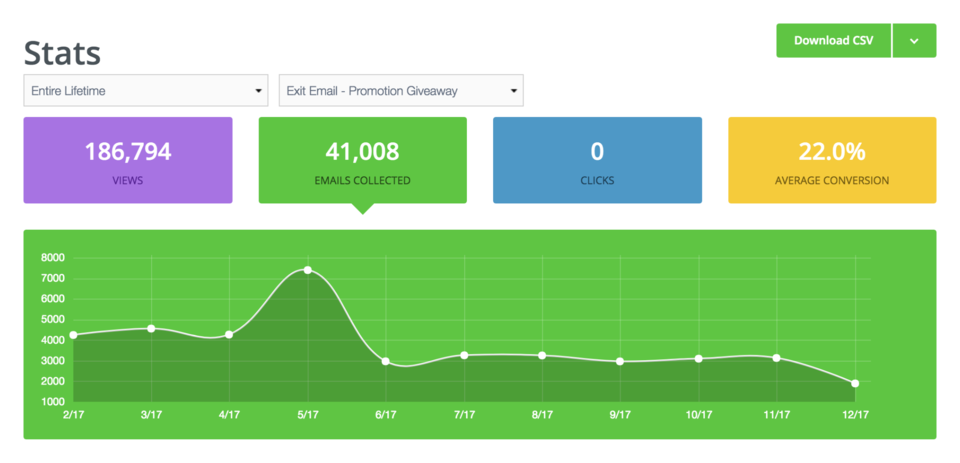
Good things come in twos… Two tacos are better than one. (Who only gets one taco, anyway?!) Two high-fives are cooler than one. And two bonus gifts are waaay more fun than one bonus gift. Because we’re a fan of twos, we convinced Santa to drop off an extra after-hours gift. Today, we’re back with your second bonus gift… How Hemper used a Sumo exit intent popup to generate 41,008 leads. With so many cool websites on the web, many of us have “TMTS” aka “Too Many Tabs Syndrome.” It’s easy to jump from page… to page… to page. But what if you could turn those people who are about to leave into email subscribers? Customers? Lifelong fans? In this email I’m going to show you how Hemper took advantage of “TMTS” and got insane results:
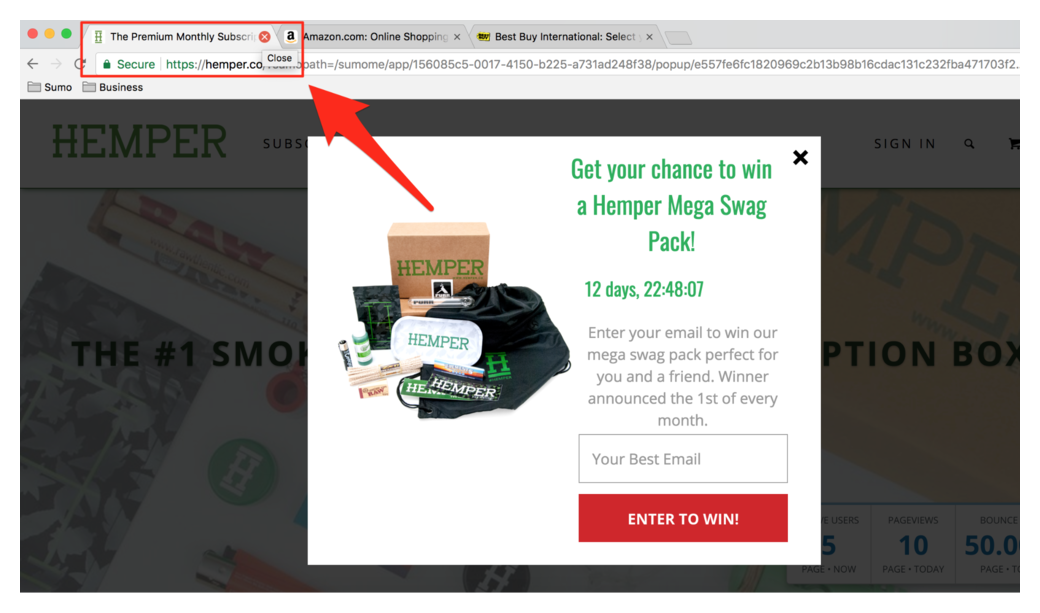
Hemper has grown their email list from 0 to 41,008 email subscribers (so far) in ten months by using one simple “exit intent” popup. When a user mouses out of the Hemper website, the exit intent popup triggers.
To create an exit intent popup like this for your eCommerce business — and get a 22% conversion rate — there are 4 key conversion elements you need:
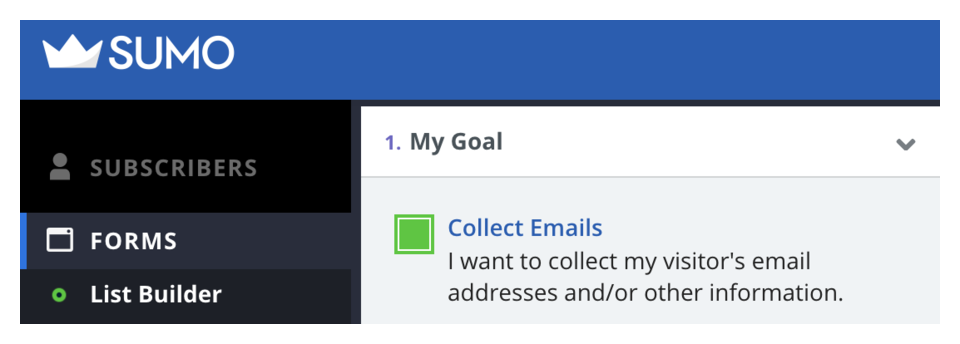
To make setting up a winning exit intent popup a breeze, here’s how you can use Sumo to set up the same exact popup as Hemper: 1. Log into Sumo and create a new List Builder form. 2. Set your Goal to “Collect Emails”.
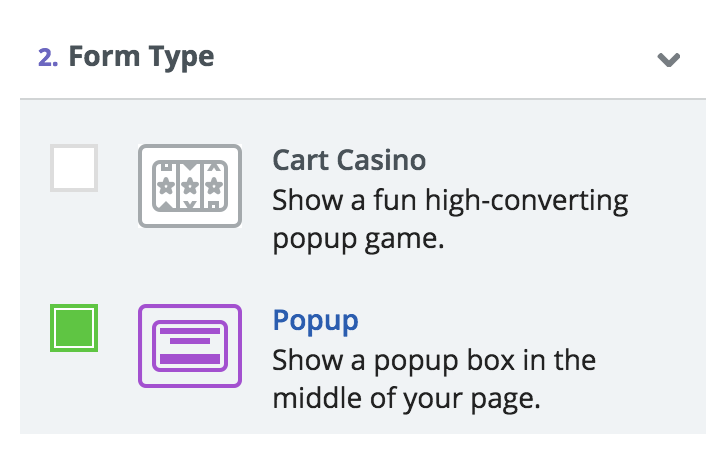
3. Set your Form Type to “Popup”.
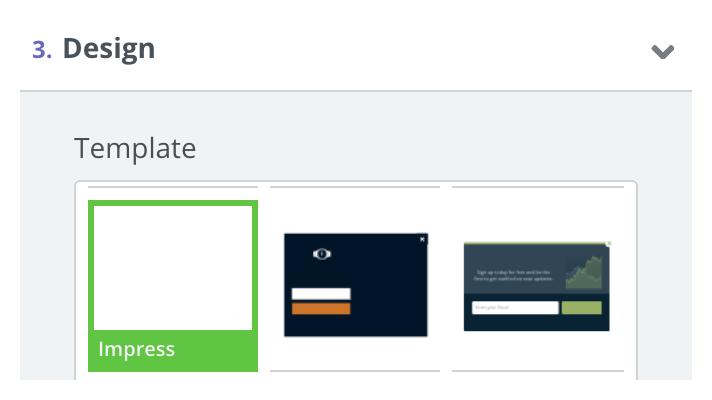
4. Set your Design to Sumo’s “Impress” template (Hemper used this template so they didn’t need to pay a designer to do design work).
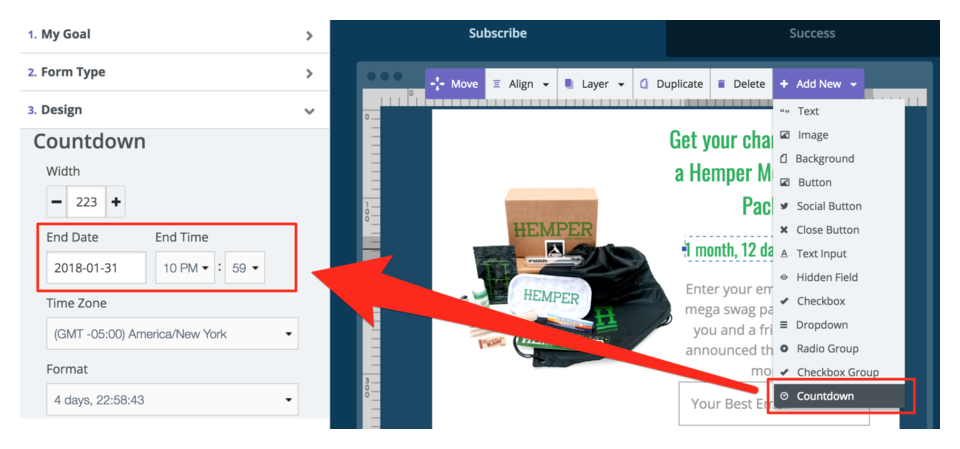
5. If you’re doing a monthly giveaway, add a “Countdown” to your design, then set your End Date to be at the end of the current month.
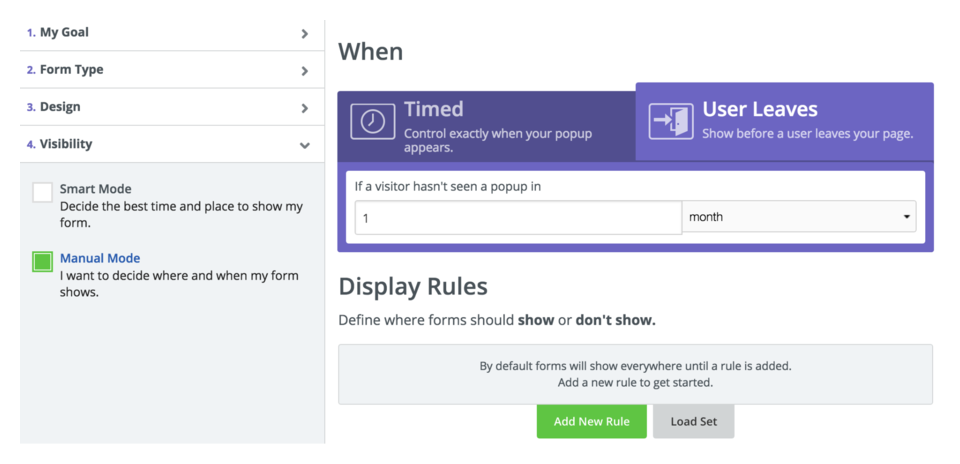
6. Set your Visibility to “Manual Mode” and only show to people who haven’t seen a popup in 1 month (Hemper does this so repeat visitors don’t get annoyed).
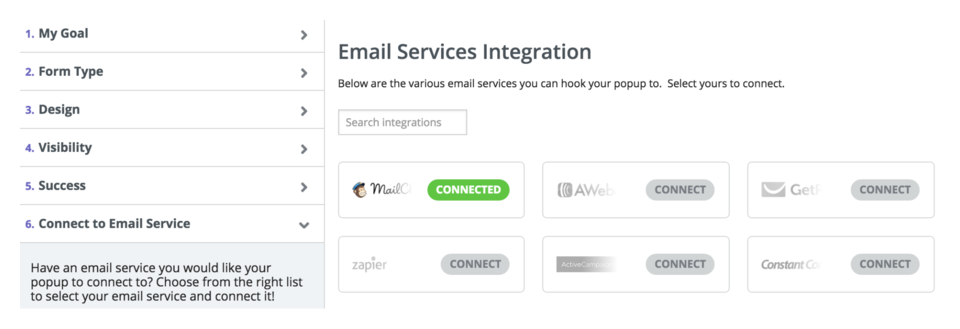
7. Connect your email service provider so you can email your leads with content, offers, and more giveaways. Or, use Sumo Message Center to send emails to your subscribers without spending money on a separate email service provider.
With this one simple exit intent popup, Hemper gets thousands of new emails leads EVERY month. The best part… All Hemper has to do is change the countdown timer at the start of each month. This 5 second task resets the giveaway and continues generating thousands of email leads. To get access to the same exit intent technology and template Hemper used to build this popup, click here to create the popup in Sumo. Chris “Closing Extra Tabs” Von Wilpert Chief Content Sumo |
Powering Up 🎆 Exciting New Year 💌
| One Amazing Year. And Another One Will Follow.2017 was the squirrliest year yet for our company. In our 5th year we’ve created the most impressive launches and updates. We’re not stopping here. Your support and trust were invaluable. Thanks to all your help and feedback we’re now powering up to get everything ready for the new Launch Dates we’ll have. I’m saying that “another one will follow”. However, it might be that this new year will lead, and not just follow. Considering all the plans we have for Squirrly SEO, Starbox, ContentLook, the Content Writing Agency and the new launches, things might just get way better for you. During 2017: Squirrly SEO went from the 2016 version to: – 2017 – 2018 – 2018: Steve – and now: 2018: Briefcase. (which comes with Briefcase and Advanced Analytics) There was a silent launch for Squirrly SEO 2018: Briefcase to make sure everything works really well. Soon, we’ll bring you a lot of info on why we created the update and how to get the most out of it. Briefcase can become the Core of your SEO Strategy and soon you’ll see why. Also, you can now optimize for multiple keywords. More on this later. The Education cloud and HSEO.tv were opened for the public in 2017 as well. For 2018, there will be a new massive version of Squirrly SEO, called Squirrly SEO 2019, and as always PRO users will receive it without having to pay any extras. We’ll also release re-written versions of Starbox and ContentLook (they are a lot of work, but I think you’ll love them) We began working on what we’re currently calling (internally): the BackLinks Assistant. Our Settings Assistant helps you get your SEO Settings right inside your WP install, our Live Assistant helps you optimize your content to 100%. This new assistant will help you earn more backlinks, by following white hat methods. The product is still super early and it’s not the only one you’ll be able to try out this year. |
| Get VIP Access and see the BackLinks Assistant many months before anyone else |
| Keep ranking, Florin Muresan CEO of Squirrly |